Torque model
Pedal demand is first converted to a torque request. Unless the torque model is updated, raising boost alone achieves nothing; the ECU pulls it back.

The G20 320i sold in Turkey does not use the same engine as the 320i in the rest of the world. Under the bonnet is not the 1,998 cc unit but the 1,597 cc B48B16. That difference changes the whole calibration — and this exact car is our verified coverage.
The reason is tax, not engineering. Turkish special consumption tax brackets are set by engine displacement, and the rate jumps sharply above 1,600 cc. Like many manufacturers, BMW offers a variant that stays under the threshold: the B48B16.
It is a member of the B48 family: same architecture as its 2.0-litre sibling, smaller swept volume and therefore different factory torque maps. Factory output is 125 kW — 170 metric horsepower (PS).
In practice this means most "320i tune" files you find online were built for 2.0-litre cars. Same badge, different engine. Loading them on a Turkish 320i does not give a correct calibration.
On a small-displacement turbo engine the priorities differ from a large one.
Pedal demand is first converted to a torque request. Unless the torque model is updated, raising boost alone achieves nothing; the ECU pulls it back.
A small engine makes the same power at a higher boost ratio. If the temperature-based pull-back thresholds are not handled, the car falls off noticeably in summer.
On direct injection an octane difference goes straight into timing. A calibration built without knowing your fuel is either unsafe or leaves power on the table.
Injector duty and rail pressure are the real limit on how far the target can go. One of the first things we look at in a log.
The ECU in this car. Read, write, coding and unlock detection were verified end to end on this unit.
Cars built after June 2020 ship locked. The app checks for free — unlock page.
Factory output 170 PS. Figures in metric horsepower (PS).
280 and 300 on stock hardware; 320 needs a downpipe and suitable fuel. The stage is chosen from datalog data.
280 and 300 are delivered on stock hardware, software only. 320 needs a downpipe and fuel support — turbo and injectors stay stock on all three.
| Package | Power | Hardware | Gain |
|---|---|---|---|
| Stock | 170 HP | factory | — |
| 280 HP Package | 280 HP | stock hardware | +110 HP |
| 300 HP Package | 300 HP | stock hardware | +130 HP |
| 320 HP Package | 320 HP | downpipe + fuel | +150 HP |
Figures are metric horsepower (PS) as used in Turkey; the UK bhp equivalent is slightly lower (170 PS = 168 bhp). 320 is not delivered on stock hardware — a downpipe must be fitted and the fuel must suit it; that is Stage 2 territory. Which stage suits your car depends on fuel quality, maintenance and what we see in a road log — datalog analysis exists for exactly that.
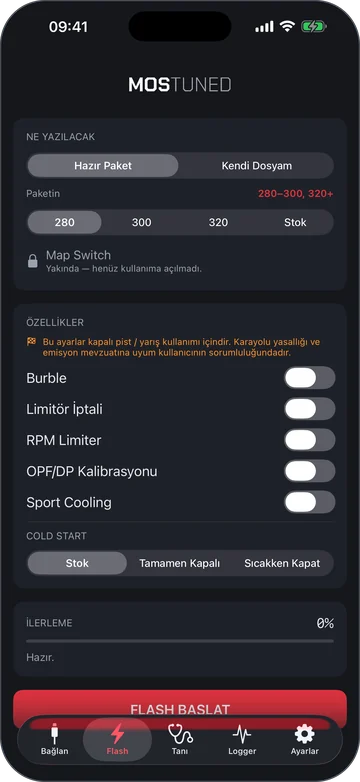
Alongside the power stage, toggles you control from the app. For track / closed-road use; road legality is the user's responsibility.
Controlled crackle and pops from the exhaust. Rev range, speed and intensity are set from the app — without risking engine health.
Silences the high-idle, noisy warm-up on cold starts. Quiet mornings — fully off or off once warm.
Removes the factory electronic speed limit (Vmax).
Adjusts the rev limit to suit your stage.
Compatible calibration for particulate-filter delete or downpipe cars.
Earlier, more aggressive cooling for high load and track use.
Enter your VIN, pay right here on the site; access is granted automatically after payment. Prices in EUR.
Already own the Flasher? 280/300 HP package €500, 320 HP add-on €200, both together €700. Pick your car and situation on Find my package to see the right price. You can check your car's eligibility for free from the app before buying.
You choose the stage and the extra toggles on the app's Flash screen. The package card shows the stages authorised for your VIN — without access, the option does not open.
Exhaust sound (crackle), speed limiter and cold-start behaviour are separate switches; which ones suit your car we decide together.
Once the write starts, progress and a log of every step scroll on screen. You do not need to leave the app before it finishes.
Wanting the biggest number is natural, but the right stage depends on the car's own condition. On a car with worn plugs, carbon build-up or low-octane fuel, the top stage produces constant knock correction instead of power — the ECU backs off and you are left with a car worse than the stage below.
That is why a healthy car matters. If you like, we take a road log and confirm knock, boost and air-fuel together — but the files are tested, and a log is not mandatory.
Moving between stages is possible. Because the software is updated through the app, stepping up when your car is ready does not mean going anywhere.
Engine displacement is on the registration document. A G20 320i bought new in Turkey is almost certainly 1,597 cc. The app also reads the ECU and software version on connection, and we confirm from there.
The torque model and fill calculations are built for a different swept volume, so the car does not behave as expected; at best it corrects constantly. Not something to do.
Our verified coverage is the Turkish-market 1.6 B48B16: 320i (G20), 420i (G22/G26), 520i (G30) and X3 sDrive20i (G01). For other variants we check compatibility first and say plainly if it is not supported.
No. We prepare the calibration; you write it to your own car with the app and an ENET/WiFi adapter.
WhatsApp: +90 547 470 40 40
Email: [email protected]
Instagram: @mostuned
Istanbul · Monday–Saturday 09:00–20:00 (TR time) · Remote service by appointment
Send your model, hardware and goal — we will pick the right package together. We do not sell what does not fit.